 Iguazu Falls Boat Tour
Iguazu Falls: Argentina or Brazil Side?
Last reviewed September 2026
Deciding between the Iguazu Falls Argentina or Brazil side comes down to one number: Argentina holds roughly four fifths of the waterfalls, and Brazil holds the view of them. This page sets both banks against each other on entry price, walking time, the boats and the closure that is currently reshaping the answer, using the tariffs each concessionaire publishes. The listings themselves are compared on our Iguazu Falls boat tour page.
Quick answer Which side to pick with one day, and what each bank actually gives you
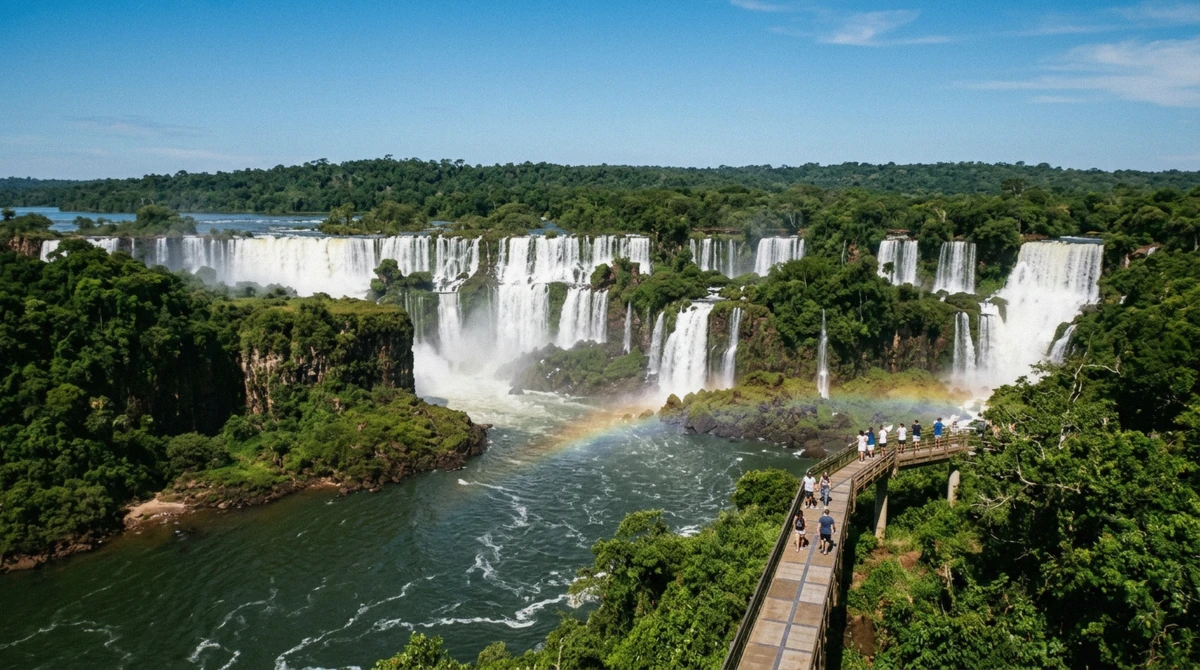
Argentina holds about four fifths of the waterfalls and Brazil holds the view of them. That single fact settles most of the argument: the Argentine park is where you walk among the falls for hours on circuits at water level, and the Brazilian park is where you stand back and see the whole horseshoe at once in two to three hours. With one day, take Argentina if you want to be in it and Brazil if you want to photograph it. This season the calculation has shifted, because the Argentine Devil's Throat catwalk has been closed since 3 August 2026 with no reopening date, which removes the Argentine side's single most famous viewpoint and leaves the Brazilian walkway as the closest open view of the same gorge.
Key takeaways
- Argentina has roughly 80 per cent of the falls; Brazil has the panorama, and both have a boat
- One day and you want the walking: Argentina, AR$60,000 entry - the Argentine boat listings start there
- One day and you want the picture: Brazil, R$131 entry, and Macuco Safari leaves every 20 minutes
- The Devil's Throat catwalk is closed, which currently favours the Brazilian bank
- Two days is the honest answer, and both parks price a second day cheaply
- The boats are different too: Gran Aventura is the longer run, Macuco the more flexible one
The Short Answer, and the Numbers Behind It
Argentina to walk, Brazil to look
The border runs through the middle of the falls, and the split is not even. Roughly four fifths of the individual waterfalls sit on the Argentine side, along with the network of catwalks that lets you stand above, below and beside them. The Brazilian side has the minority of the water and the majority of the view, because it faces the Argentine wall of falls across the gorge.
So the two parks are not competing versions of the same day. Argentina is several kilometres of walkway and a full day at minimum. Brazil is a single 1.5 km trail that most people finish in two to three hours, ending on a walkway that projects out below the Garganta do Diabo with water on three sides.
Side by side, on the things that decide it
The figures below come from the two concessionaires: iguazuargentina.com for the Argentine park and the official Cataratas do Iguacu ticket shop for the Brazilian one, both read in September 2026, with the boat prices from Iguazu Jungle and Macuco Safari.
| Argentina | Brazil | |
|---|---|---|
| Share of the falls | About 80 per cent | About 20 per cent |
| What you get | Circuits at water level, several hours of walkway | One panoramic trail, 1.5 km, two to three hours |
| Entry, foreign visitor | AR$60,000 | R$131 |
| Entry, regional | AR$25,000 residents, AR$8,000 Misiones | R$118 Brazil and Mercosur |
| The boat | Gran Aventura, AR$100,000, fixed departures | Macuco Safari, R$384, every 20 minutes |
| Minimum age on the boat | 12 | Under-7s free, 7 to 11 half price |
| Time needed | A full day | A half day |
| Closed this season | Devil's Throat catwalk, since 3 August 2026 | Nothing |
What the closure changes
Until August the Argentine answer was easy: the Garganta del Diablo catwalk, 1.1 km out over the river to a platform on the lip of the gorge, was the single most powerful thing either country offered. It has been closed since 3 August 2026 as a preventive measure against forecast flooding, the walkway decking was lifted out, and no reopening date has been published.
Everything else on the Argentine side runs normally, and the boat is unaffected. But a visitor choosing one bank for one day in 2026 is choosing between the Brazilian panorama of the Garganta and the Argentine circuits without their finale. The full closure picture is here.
Which Side, in One Line
If You have one day and want to be among the falls
Argentina. The Upper and Lower circuits put you level with the water for hours, and the boat runs from inside the same park.
If You have one day and want the photograph everyone recognises
Brazil. The Cataratas trail looks straight at the Argentine wall and ends below the Garganta do Diabo.
If You are travelling with children under 12
Brazil. Macuco Safari carries under-7s free and 7 to 11 at half price; the Argentine boat refuses under-12s at the dock.
If You are based in Foz do Iguacu and have half a day
Brazil, with the private half-day if you want the trail before the coaches arrive.
If You are based in Puerto Iguazu
Argentina, and the packages with the park ticket inside save you a queue at the window.
If You have two days
Both, one park a day. The two-day private itineraries do exactly that, and the river gets a second chance at the boat.
What a Day on the Argentine Side Looks Like
The circuits
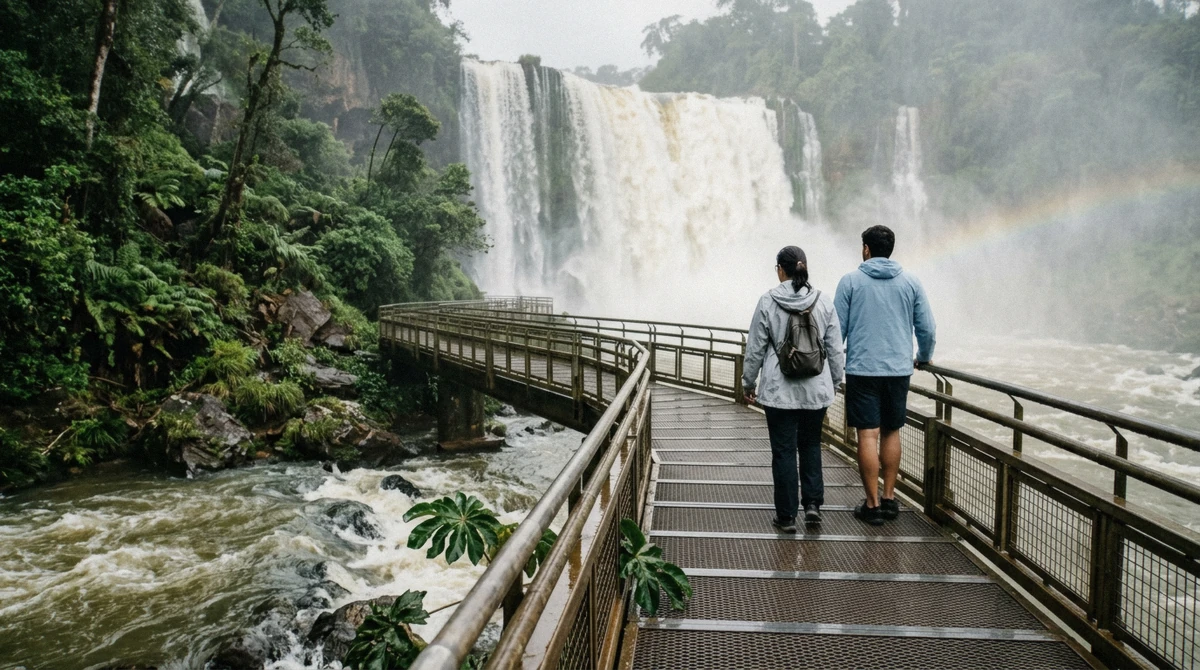
The Argentine park runs on an internal narrow-gauge train, the Tren Ecologico, which is included in the entry price and carries visitors between the trail heads. From the central station the Upper Circuit runs along the tops of the falls with the least spray on your lens, and the Lower Circuit drops to water level, where the walkways pass directly beneath several cascades and the noise becomes physical.
Both are flat, both are paved and both take longer than the map suggests, because the platforms fill and nobody moves quickly on them. Allow two hours for the pair without stopping, and four if you intend to enjoy them.
San Martin island, and the boat
Between the two circuits sits Isla San Martin, reached by a free launch when the river level allows it and closed when it does not. The boat excursion is a separate business: Gran Aventura, run by Iguazu Jungle under the park's nautical concession, at AR$100,000 for about two hours including the truck ride down the Yacaratia trail.
That is the Argentine day at full stretch: train, two circuits, the boat, and the walk between them. It is why every Argentine package on this site runs eight to twelve hours.
What the entry price covers
Admission covers the circuits, the Tren Ecologico and the park's visitor centre, and it is priced by document rather than by nationality of birth: AR$60,000 for international visitors, AR$25,000 for residents of Argentina, AR$15,000 for Argentine students with a valid enrolment card, AR$8,000 for residents of Misiones, and nothing for under-6s, national pensioners, people with disabilities and Malvinas veterans.
A second consecutive day is sold at a reduced rate on the same ticket, which is the park's own way of saying one day is tight. Every published tariff on both banks is set out here.
What a Day on the Brazilian Side Looks Like
One trail, and the platform at the end
The Brazilian park works differently. Double-decker park buses run the road inside from the visitor centre at km 18 on the BR-469, and almost everyone gets off at the same place: the head of the Trilha das Cataratas, about 1.5 km of walkway along the canyon wall with the Argentine falls opposite the whole way.
It ends on a walkway built out into the river below the Garganta do Diabo, where spray lands on everyone and nobody minds. A lift carries visitors back up to the road. Two to three hours covers it comfortably, which is why Brazilian itineraries pair the trail with something else.
Macuco Safari, and what else fills the day
The something else is usually the boat. Macuco Safari runs from km 25, further inside the park: a 2 km ride in electric vehicles, a 600 m walk down to a river deck, then a twin-engine boat out to the falls. Departures leave every 20 minutes from 09:00 to 17:00 with no timed slot to book, which makes the Brazilian day the more forgiving of the two for anyone travelling independently.
Beyond that the Brazilian side has the Poco Preto and Bananeiras trails, a cycle path and the bird park outside the gate, none of which are on the tours compared here.
What the entry price covers
R$131 for foreign visitors and R$118 for Brazilians and Mercosur nationals covers entry, the internal buses and the Cataratas trail. A two-day ticket is discounted by 40 per cent, tied to your name and a photo document, and not transferable.
Half-price entry exists for Brazilian children aged 7 to 11, students, over-60s and residents of the fourteen municipalities bordering the park under the Passe Comunidade, and under-7s go free. Those discounts are for Brazilians, and no packaged tour can pass them to a foreign visitor.
If You Genuinely Only Have One Day
Where you sleep decides more than the falls do
An international border sits between the two parks, and crossing it costs an hour each way on a busy morning plus a passport check in each direction. If your hotel is in Foz do Iguacu, the Brazilian park is 25 km away and the Argentine one is 25 km plus a border. If your hotel is in Puerto Iguazu, the reverse.
That is why the one-day answer is usually the side you are already standing on. The exception is the traveller who booked the wrong town for their priority, which is exactly what the cross-border listings exist to fix.
The distances below are the reason, not the scenery.
| Staying in | Nearest park | Distance | The other side |
|---|---|---|---|
| Puerto Iguazu, Argentina | Parque Nacional Iguazu | 17 km on Ruta 101, about 40 minutes by bus | Border crossing plus 25 km |
| Foz do Iguacu, Brazil | Parque Nacional do Iguacu | 25 km on the BR-469, about 35 minutes on the 120 bus | Border crossing plus 17 km |
| Either town | The boat | Inside the park you are already in | Bought at that park's own counter |
Doing both in one day, honestly
It is possible, about two thousand reviewers on one listing here have done it, and the compromise is depth. Half a day on each bank plus a border crossing in the middle leaves you the headline trail on each side and no time for the quieter circuits.
The cheapest both-sides day prints both gate tariffs on its own listing and leaves the boat as an option, which is the honest structure for a day this compressed. The alternative is a private crossing, where the car waits for your queue rather than a coachload.
The second day is the cheap one
Both concessionaires discount it. Argentina sells a second consecutive day at a reduced rate; Brazil takes 40 per cent off a two-day ticket. Neither park is trying to sell you a longer holiday for the sake of it, and the pricing tells you what they know about how long their own site takes.
If you can stretch to two days, the shape that works is Brazil first for the overview, Argentina second for the detail, with the boat on whichever morning the river is behaving.
Argentina or Brazil: Questions People Ask First
Which side of Iguazu Falls is better?
Argentina if you want to walk among the falls, Brazil if you want to see all of them at once. Argentina holds about four fifths of the water and several kilometres of walkway; Brazil holds the panorama and a trail most people finish in two to three hours. In 2026 the Brazilian case is stronger than usual, because the Argentine Devil's Throat catwalk has been closed since 3 August.
How much time do you need on each side?
A full day for Argentina and a half day for Brazil. The Argentine circuits plus the Tren Ecologico take three to four hours before you add the boat, and the Brazilian Cataratas trail takes two to three. That asymmetry is why two-day itineraries put one park on each morning rather than splitting a single day evenly.
Can you visit both sides of Iguazu Falls in one day?
Yes, with a border crossing in the middle and a shortened stop on each bank. It works best from Foz do Iguacu, where the Brazilian park is close enough to do early and the Argentine one is reachable by late morning. Expect ten hours and a passport check in each direction.
Which side has the better boat ride?
They are different rather than better. Gran Aventura in Argentina is the longer run, 6 km upriver through rapids to San Martin, at AR$100,000 with fixed departures and a minimum age of 12. Macuco Safari in Brazil is R$384, leaves every twenty minutes with no slot to book, and takes children from seven at half price.
Do you need a passport to cross between the two parks?
Yes, at both immigration posts on the Tancredo Neves bridge. Visa rules apply separately for each country, and travellers from the United States, Canada and Australia need a Brazilian e-visa obtained before travel because it cannot be bought at the border.
Which side is better for wheelchair users?
Both parks have made their headline trails accessible, and the Brazilian one is generally the easier: a paved walkway with a lift at the Garganta end and buses that take wheelchairs. On the Argentine side the Upper Circuit is the most accessible section. Boat access on either bank varies with river conditions, so confirm it with the operator rather than assuming.