 Iguazu Falls Boat Tour
Iguazu Falls With Kids
Last reviewed September 2026
Visiting Iguazu Falls with kids works better than most natural attractions, because both parks are built around flat paved walkways with a train on one side and buses on the other. The complication is the boats: the Argentine one refuses under-12s at the dock and the Brazilian one takes children from seven at half price. This page sets out the age rules, the family prices and how to build the day around them. The tours are compared on our Iguazu Falls boat tour page.
Quick answer The age rules on each boat, and how to build a day around a child who cannot board
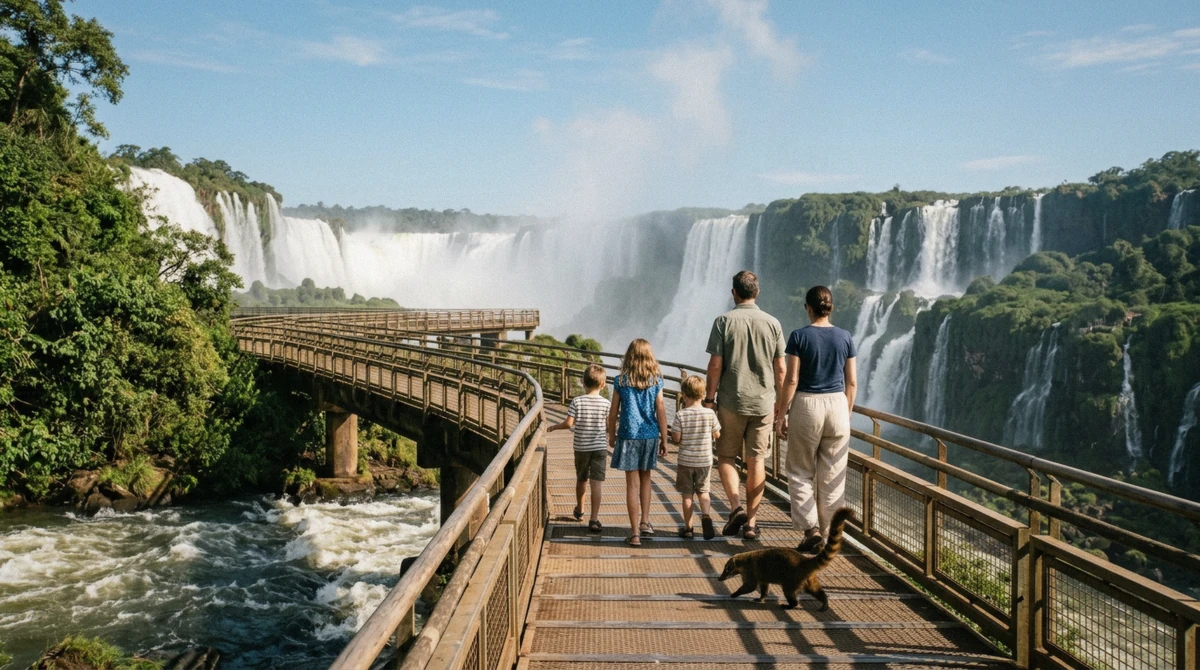
The two countries treat children completely differently. On the Argentine side nobody under 12 boards La Gran Aventura, the rule is the concessionaire's and it is enforced at the dock rather than at checkout. On the Brazilian side Macuco Safari carries under-7s free and children aged 7 to 11 at half price, with its own boarding conditions applying on the day. That single difference decides most family itineraries this season, because the gentle Argentine alternative, the calm-water Paseo Ecologico, is suspended while the Devil's Throat station is closed. Both parks are otherwise excellent for children: flat paved walkways, a train on the Argentine side, buses on the Brazilian one and wildlife along every path.
Key takeaways
- Gran Aventura refuses under-12s, and the crew check at the dock
- Macuco Safari is free under 7 and half price from 7 to 11 for Brazilians
- The Argentine calm-water trip is suspended this season, removing the family option there
- Argentine park entry is free for under-6s; Brazilian entry is discounted for Brazilian children
- Walkways on both banks are flat and paved, and the Argentine train is included in the ticket
- Coatis look tame and bite; feeding them is prohibited on both sides
The Age Rules, Bank by Bank
Argentina: twelve, and no exceptions
Iguazu Jungle sets the minimum age for La Gran Aventura at 12 and publishes it on its own safety page. Every Argentine listing on this site repeats it, and the crew apply it at Puerto Macuco rather than at the point of sale, which is how families discover it with a ten year old in a life jacket.
The reasoning is the same one behind the operator's long medical exclusion list: the test is whether a passenger could respond physically in a nautical emergency on the lower Iguazu River, including gripping rescue equipment. A refused boarding is not a cancellation, so this is a rule to read before paying.
Brazil: seven, and half price
Macuco Safari publishes a different structure entirely. Children up to six years old go free, children between seven and eleven pay half price, and the same half-price rule covers Brazilian students, over-60s and residents of the fourteen municipalities bordering the park under the Passe Comunidade. Those discounts are for Brazilians; a foreign family pays the full R$384 per person.
Access to the boat itself still depends on river conditions, and the operator asks visitors to check before buying rather than promising anything, so a family should confirm on the day rather than assume.
What each side charges for children
Park entry and boat prices for families, read from the concessionaires' own sites in September 2026.
| Argentina | Brazil | |
|---|---|---|
| Park entry, adult foreign visitor | AR$60,000 | R$131 |
| Park entry, young children | Free under 6 | Discounts apply to Brazilian children |
| Boat | AR$100,000 | R$384 |
| Boat minimum age | 12, enforced at the dock | Under 7 free, 7 to 11 half price |
| Calm-water alternative | Paseo Ecologico, AR$40,000, suspended | Macuco Selva, R$192, running |
| Getting around inside | Tren Ecologico, included | Double-decker park buses, included |
Building the Day Around Your Children
If Your children are under 12 and you want them on a boat
Brazil. Macuco Safari takes them from seven at half price, and under-7s go free.
If Your children are 12 or over
Either bank. The Argentine boat is the longer run and the wetter one.
If You have a toddler and a teenager
Split the day. One adult takes the teenager on the boat while the other walks the circuits; both banks make that easy.
If You want a boat everyone can board on the Argentine side
Not this season. The calm-water Paseo Ecologico is suspended while the Garganta station is closed.
If You have a pushchair
Brazil is the smoother trail, and the Argentine Upper Circuit is the flattest option across the river.
If You are booking a package
The private options let the day run at your children's pace rather than a coach's.
What Actually Works With Children
The walkways
Both parks are built around flat, paved, railed walkways, which makes them unusually easy with children compared with most natural attractions. The Brazilian Trilha das Cataratas runs about 1.5 km one way with a lift at the far end, and the Argentine Upper Circuit is the flattest and shadiest of the Argentine trails.
Distance is the thing to manage. The Argentine Lower Circuit involves stairs and takes longer than it looks; a family that starts there in the middle of the day usually finishes it in a bad mood.
The train, the buses and where the queues are
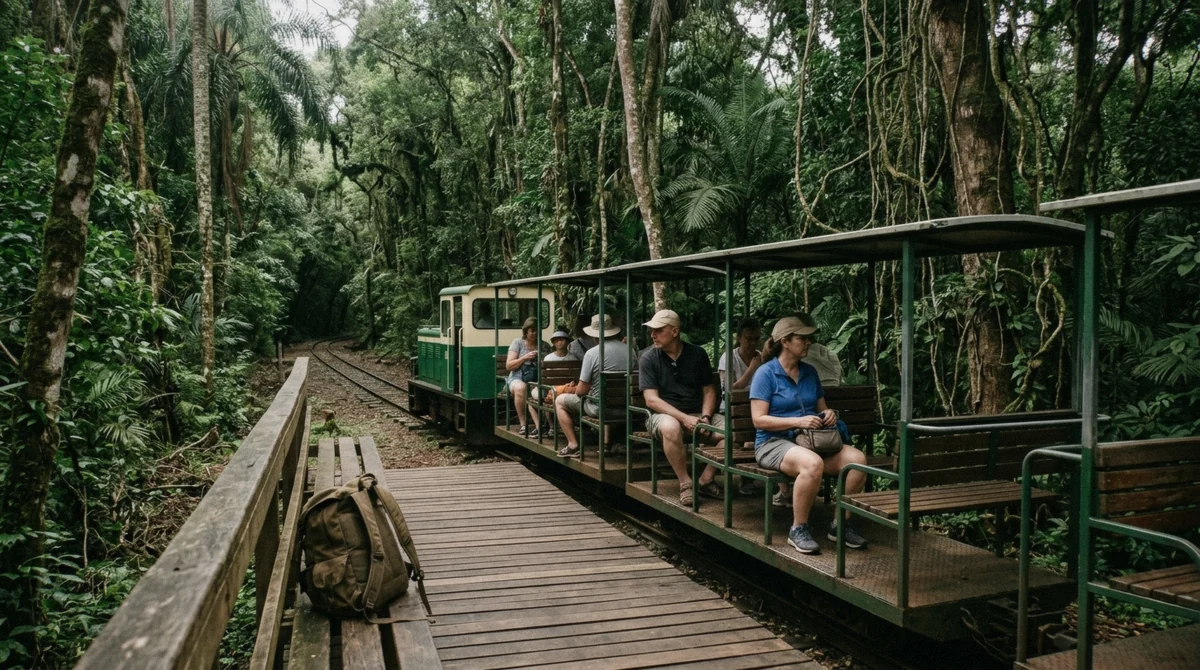
The Argentine ticket includes the Tren Ecologico, which carries visitors between trail heads and is itself a small event for younger children. Queues for it build from mid-morning, which is the main argument for an early start.
On the Brazilian side the double-decker park buses are included in the entry ticket and run the internal road continuously. Neither park requires you to walk between the entrance and the trails.
Wildlife, and the animal to actually worry about
Coatis patrol both parks and they are entirely used to people. They look like a photo opportunity and they are the reason both parks post warnings: they scratch and bite when food is involved, and feeding them is prohibited on both banks.
Keep food inside bags, do not let a child hold a snack at coati height, and treat them like the wild animals they are. Butterflies, toucans and capuchin monkeys are the harmless half of the same encounter, and they are everywhere along the trails in the early morning.
Practicalities Nobody Mentions Until You Are There
Timing a day around small children
Arrive at opening. Both parks are quiet for the first hour, and the temperature in summer makes anything after midday hard work with children, with highs of 30 to 31 C from December to February. An early start also gets the boat done before the heat and leaves the afternoon for the shaded circuits.
Budget more time than the tour descriptions suggest. A twelve-hour Argentine package is a long day for a six year old; an eight or nine hour listing covers what is open this season without the extra coach time.
| Age | On the Argentine side | On the Brazilian side |
|---|---|---|
| Under 6 | Free entry; no boat | Free on Macuco Safari for Brazilians; walkway fine |
| 7 to 11 | Pays entry; refused on Gran Aventura | Half price on Macuco for Brazilians; boat allowed |
| 12 to 17 | Full entry; boat allowed | Full price; boat allowed |
| Adults | AR$60,000 entry, AR$100,000 boat | R$131 entry, R$384 boat |
| Over 60 | Full price | Half price at the Macuco window for Brazilians |
Wet clothes, lockers and food
If one child rides the boat, that child comes back soaked, and there is nowhere private to change. Bring a full change of clothes, use the lockers at the Argentine entrance at AR$13,500 to AR$21,000, and pack a plastic bag for the wet set.
Food inside both parks is available and priced accordingly. Bringing your own is normal, and it is another reason to keep it sealed in a bag rather than open in a hand, given the coatis.
Two days, at a child's pace
Two days is the format that works with children, one park a morning, with the afternoons free. Both concessionaires discount the second day, and the two-day private itineraries run one park a day with a vehicle that waits.
It also solves the boat problem quietly: if the Brazilian morning gets the boat, the Argentine day can be a walking day, and nobody spends an hour explaining to a nine year old why the crew will not let them board.
What to Bring for a Family Day
The list that prevents the arguments
Most of what goes wrong on a family day here is preventable with a bag packed the night before. The walkways are long, the sun is strong, the spray is constant and there is nowhere to buy a dry t-shirt inside either park.
- A full change of clothes for anyone going on the boat, in a sealed bag
- A microfibre towel, which dries far faster than a hotel towel
- Sunscreen applied before you enter and again after the boat
- Insect repellent for the shaded forest sections
- Hats with straps, because the boat takes the loose ones
- Sealed snacks and water, kept inside a bag away from the coatis
- Cash in local currency for the Puerto Iguazu tourist tax and small purchases
- Passports for everyone, including children, if you are crossing the border
Strollers, carriers and the sections that defeat wheels
A stroller works on the Brazilian trail and on the Argentine Upper Circuit, and it is a nuisance on the Argentine Lower Circuit, which has stairs. A carrier is the better answer for anyone under three on the Argentine side.
Both parks are otherwise unusually stroller-friendly for a rainforest attraction: paved surfaces, gentle gradients, lifts where the terrain drops and internal transport included in the ticket on both banks.
Iguazu Falls With Kids: Questions Parents Ask
What is the minimum age for the Iguazu Falls boat ride?
Twelve on the Argentine Gran Aventura, enforced at the dock by the boat crew. On the Brazilian side Macuco Safari carries children from birth, with under-7s free and 7 to 11 at half price for Brazilians, subject to its own boarding conditions on the day.
Is Iguazu Falls suitable for young children?
Yes for the parks themselves. Both are built around flat paved walkways with railings, the Argentine ticket includes a train between trail heads and the Brazilian one includes buses. The limitation is the boat, and on the Argentine side this season also the closed Devil's Throat circuit.
Which side of Iguazu Falls is better with kids?
Brazil, for two reasons: the boat takes children from seven at half price, and the main trail is shorter at about 1.5 km with a lift at the end. The Argentine side is the bigger day out and better suited to families whose children are all twelve or over.
Do children pay to enter Iguazu Falls?
On the Argentine side under-6s enter free, and the same exemption covers national pensioners, people with disabilities and Malvinas veterans. On the Brazilian side the published discounts apply to Brazilian children, students and over-60s rather than to foreign families.
Are the coatis at Iguazu Falls dangerous?
They bite and scratch when food is involved, which is why feeding them is prohibited on both banks. Keep food sealed inside bags, particularly at child height, and treat them as wild animals rather than a photo opportunity.
How long should a family spend at Iguazu Falls?
Two days, one park each morning, with afternoons free. Both parks discount the second day, and splitting the visit avoids the twelve-hour coach schedules that make young children miserable and leaves a second chance if the boat is off.
Do US citizens need a visa to bring children to Iguazu Falls?
For the Argentine side, no: United States citizens and their children visit visa-free for tourism. For the Brazilian side, yes, US, Canadian and Australian travellers need a Brazilian e-visa obtained before travel, and that includes children, each with their own application. It cannot be bought at the border, so apply weeks ahead if your family plans to cross.
Is Iguazu Falls really worth it with a young family?
Yes, with the boat treated as optional rather than the point. The walkways are flat, paved and railed, the internal transport is inside both tickets, and the wildlife along the trails holds a child's attention for hours. Families whose children are all under twelve should plan the Brazilian bank for the boat and accept the Argentine side as a walking day.